Sanctions Now with Free Trial; Putin Learns Unsubscribe Fails
Western sanctions are being marketed like subscription software: free trials, tiers, auto-renewal. The Kremlin discovers there's no unsubscribe button.
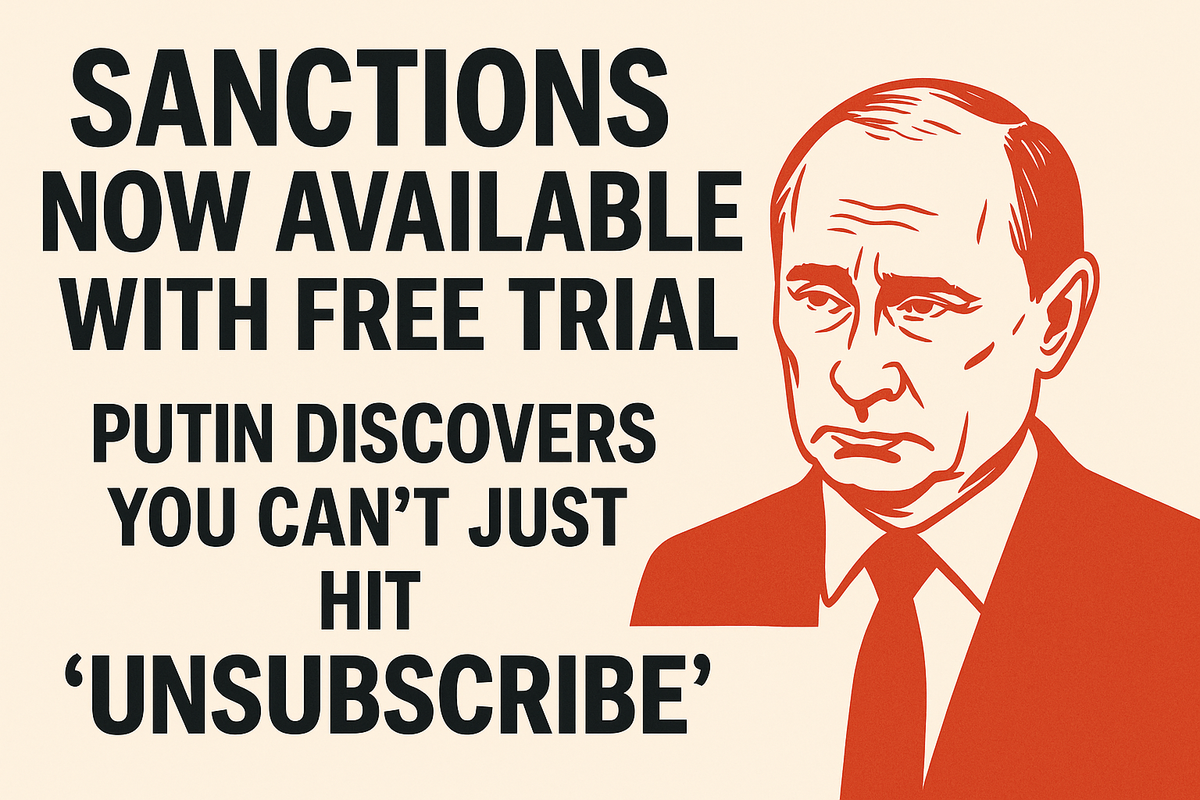
Sanctions-as-a-Service Launch Memo
Now available with a 14-day free trial, tiered penalties, and an auto-renewal clause that politely refuses to be clicked away.
In a user-experience pivot that product teams call 'inevitable,' Western governments have repackaged economic penalties as a subscription product: Sanctions-as-a-Service. It ships with a free trial, tiered features, and an auto-renewal mechanism that the Kremlin reportedly discovered does not respond to a polite 'unsubscribe.'
Executive summary
Sanctions were always tools. Now they come with onboarding flows, status emails, and a help center. The rewrite is cosmetic. The consequences are not.
Product features (global rollout)
- 14-day free trial ('Diplomatic Notice'): a soft, reversible phase for testing messaging and measuring public reaction (good for A/B testing apologies).
- Tiered escalation stack:
- Silver: travel bans and public naming
- Gold: targeted asset freezes
- Platinum: financial exclusion and trade restrictions
- Auto-renewal: sanctions persist until predefined benchmarks are met or until the coalition decides to pivot.
- Enterprise add-ons:
- Airspace Denial (Pro)
- SWIFT Blackout (Enterprise)
- Yacht Repossession (Platinum, subject to onboarding)
- PR Burn (NFT-style symbolic gestures for optics)
"We built this like any subscription: low friction to start, high friction to reverse. Churn is not the problem — compliance is."
— Heather Sans, Director of Customer Compliance, Allied Sanctions Initiative (fictional, but sincere)
How it actually works
Nothing replaces law, diplomacy, or multilateral coordination. The novelty is in the packaging. Press releases now read like product updates. Embargoes become 'feature gates' and enforcement memos become 'policy changelogs.'
The mechanics remain familiar to policy people: designations, executive orders, banking restrictions. The rest is UX.
How Western capitals describe it to stakeholders:
- KPI: days to measurable impact
- NPS: net penalty score (goes up when targets blink)
- Retention: good for policy continuity, bad for the sanctioned
Who this hurts (and why)
- Primary targets: political elites, financial intermediaries, and networks that enable objectionable policy.
- Collateral: industries, workers, and citizens who share geography or supply chains with the target.
- Market sentiment: investors who mistook geopolitics for low-latency product updates.
Kremlin attempts to 'unsubscribe'
Sources amenable to satire report that senior Kremlin staff discussed hitting 'unsubscribe' and were disappointed by the lack of a literal button. Attempts to escalate to 'chargeback' were met with a diplomatic reply and a reminder that international norms do not have a customer-support hotline.
"We clicked 'unsubscribe' on a printed letter and the paper laughed."
— Igor Rostov, Head of Domestic Unsubscribe Efforts (title manufactured for humor)
Final note
This repackaging is mostly rhetorical, but rhetoric matters. Calling sanctions a subscription doesn't make them reversible by a single click. There is no cancel flow for a policy problem. There are negotiations, compliance checks, and, occasionally, a slow rollback.
No refunds. No chargebacks. If you don't like the invoice, change the things that put you on the list.
Kicker: subscriptions are sticky. Geopolitics is stickier.
El Garlic — Because life needs a stronger flavor.